
The 3 Rivers Race On The Norfolk Broads: Why It Still Matters


An enduring sailing challenge that reflects the skill, tradition and character of the Broads
There are certain events on the Broads that do more than mark a date in the calendar. They reveal something about the waterways themselves — how they are used, understood and, in many cases, quietly mastered.
The 3 Rivers Race on the Norfolk Broads is one of those events.
Held each year in May — this year taking place over the weekend of 30–31 May — it draws together sailors who know the Broads not just as a setting, but as a working landscape. It is often described simply as a race, though that only begins to explain its appeal.
At its core, the 3 Rivers Race is a continuous sailing challenge across the Rivers Bure, Ant and Thurne. Crews set out from Horning and navigate a course shaped as much by conditions as by distance. There are no fixed stages, no pause in proceedings; progress depends on judgement, coordination and an ability to respond to whatever the rivers present.
For some, that journey extends well into the night.
A Landscape That Sets the Terms
Unlike many organised events, the 3 Rivers Race does not impose itself on its surroundings. Instead, it works entirely within them.
Low bridges require masts to be lowered and raised, often with little margin for error. Narrow stretches of river demand careful positioning, particularly as boats must pass through bridges under sail alone, without the use of engines. Wind and tide — never entirely predictable — shape both pace and possibility.
The result is a race defined not by uniform conditions, but by variation. Each year is subtly different, and each crew must adapt accordingly.

Knowledge, Not Just Speed
Success in the 3 Rivers Race is rarely about outright pace.
It lies instead in knowing when to advance and when to wait.In recognising how the tide will influence the next stretch of water.In understanding the practical realities of moving efficiently through a landscape that resists standardisation.
These are skills acquired over time, rooted in familiarity with the Broads themselves. The race rewards that depth of understanding in a way few events can.
A Shared Experience
For those taking part, the race is an exercise in concentration and endurance. For those watching, it offers something broader.
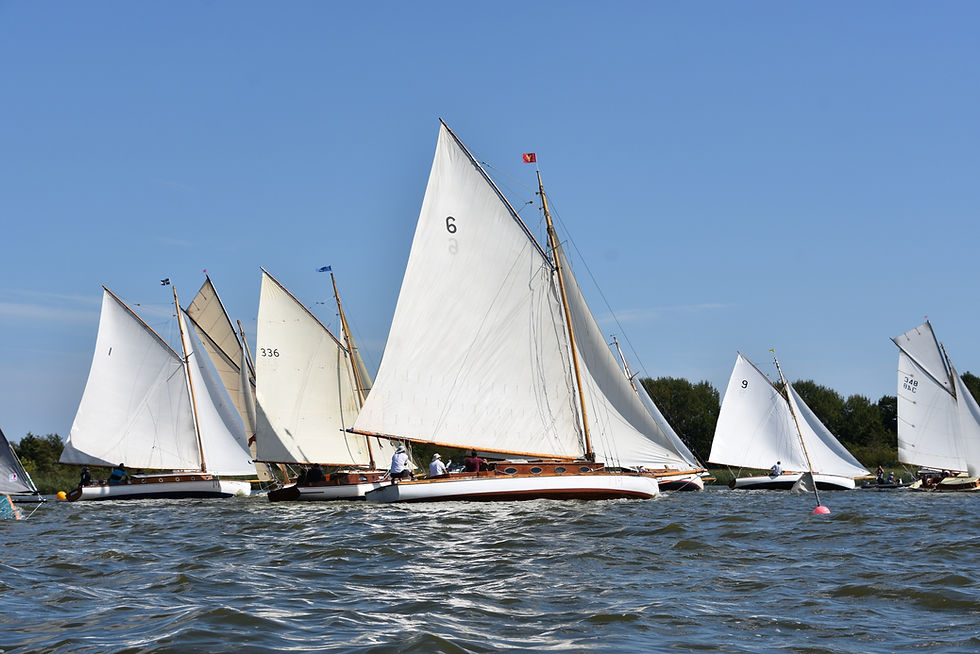
At the start, there is a moment that gathers everything together. More than a hundred boats — 127 entries this year — set off in sequence from Horning, sails lifting and settling as they find their line. Seen together on the water, they offer a striking reminder of the distinctive character of the Broads’ sailing craft.
Further along the rivers, from bridges, moorings and quieter stretches of bank, the experience changes. Boats pass in closer quarters — sails adjusted, ropes handled with precision, crews working efficiently as they navigate each challenge.
It is not spectacle in the conventional sense, but something more measured — a sense of the Broads in use, observed in fragments rather than all at once.

Why It Still Matters
Events such as the 3 Rivers Race play a role that extends beyond the participants themselves.
They demonstrate that the Broads remain an active environment — not simply to be observed, but to be engaged with thoughtfully and with skill. They sustain practices and knowledge that are closely tied to the character of the waterways, ensuring that these are not lost, but carried forward.
In doing so, they contribute to a broader understanding of what the Broads are: a place shaped as much by use as by appearance.
If You Find Yourself Along the River
For those nearby, the race offers an opportunity to see the Broads under a different kind of pressure.
Boats approach bridges with careful timing.Crews move quickly, then pause.Progress is made not in bursts, but in considered decisions.
It is, perhaps, a reminder that these waterways are not only scenic, but capable — and that their character is best understood through moments such as these.
Further Information
Further details about the race, including routes and entry information, can be found on the official 3 Rivers Race website - www.3rr.uk
Image Credits
Images courtesy of Visit the Broads and Simon Purdon


Reading this on https://casinojeton.net reminded me that timing and patience are just as crucial in sailing as they are in any unpredictable pursuit. The point about crews lowering masts under bridges with little margin for error really stood out—it’s a skill you can’t fake, much like knowing when to hold back in a game of chance. I’ve never raced on the Broads, but I’ve done enough night sailing to respect the endurance factor.